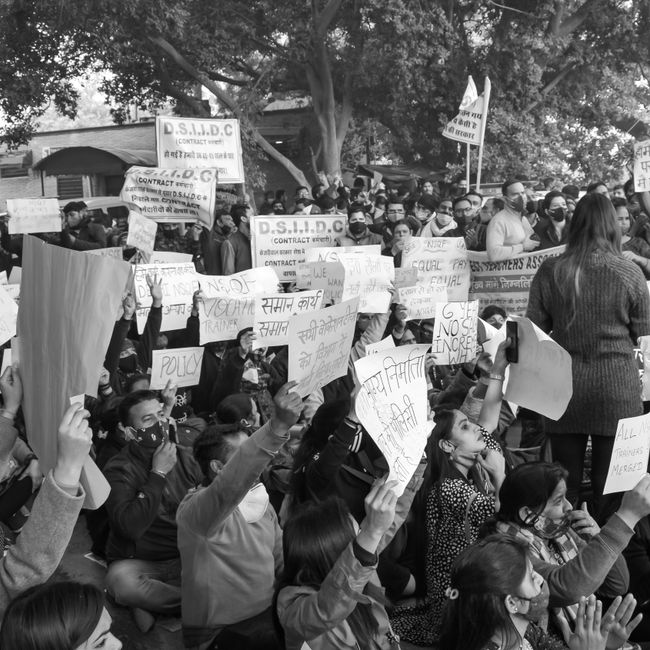
On a politically charged day in Jammu and Kashmir, two rival parties took to the streets of Srinagar with two separate agendas, but were met with sharply contrasting responses from the authorities. The Bharatiya Janata Party (BJP) staged a march towards the Civil Secretariat, targeting the elected National Conference-led government on a clutch of governance issues, including unemployment, electricity tariffs, recruitment and allegations of administrative dysfunction. Separately, the Jammu and Kashmir National Conference (JKNC) attempted to march towards the BJP's office in Jawahar Nagar to press its longstanding demand for restoration of statehood and to flag what it described as unfulfilled promises made by the Union government. Only one of the two protests was allowed to proceed.
The asymmetry lies at the heart of the political controversy. The BJP's rally against an elected state government — in itself a routine democratic act — was facilitated, while the JKNC's march against a national party over the unresolved question of statehood was stopped. Read together, the two episodes point to what critics describe as selective enforcement of public order, in which the right to demonstrate appears contingent on who is being targeted and how uncomfortable the message is for the authorities.
Opposition parties and commentators argue that the contrast is difficult to explain as a coincidence of logistics. Jammu and Kashmir continues to function as a Union Territory even though an elected government has been in office, a constitutional arrangement that the JKNC formally contests. For the JKNC, statehood restoration is not merely a slogan but a substantive question about the relationship between the popular mandate and the authority exercised from New Delhi. Its protest sought to take that argument directly to the BJP, which the party views as bearing substantial responsibility for the region's present political status.
Defenders of the government's handling counter that the BJP, as the principal opposition voice in the Assembly, has every democratic right to hold the elected administration accountable, and that the JKNC's issues could be raised within institutional forums rather than through street protests. Critics, however, point to a deeper irony: the same BJP now lecturing the elected government on unemployment, recruitment and corruption was part of the BJP-PDP coalition that governed Jammu and Kashmir for several years and helped shape the very administrative landscape it now denounces.
The episode has reignited debate over what equal democratic space means in a Union Territory that has an elected government but limited sovereign powers. JKNC spokesperson Adv. Shriya Handoo framed the day as proof that 'everyone may speak, but not everyone is permitted to be heard in the same way,' and demanded that the right to protest not depend on who is being protested against. The day's events have ensured that the question of statehood, and the more fundamental question of democratic parity between Srinagar's rival political forces, will dominate political debate in the region in the coming days.